
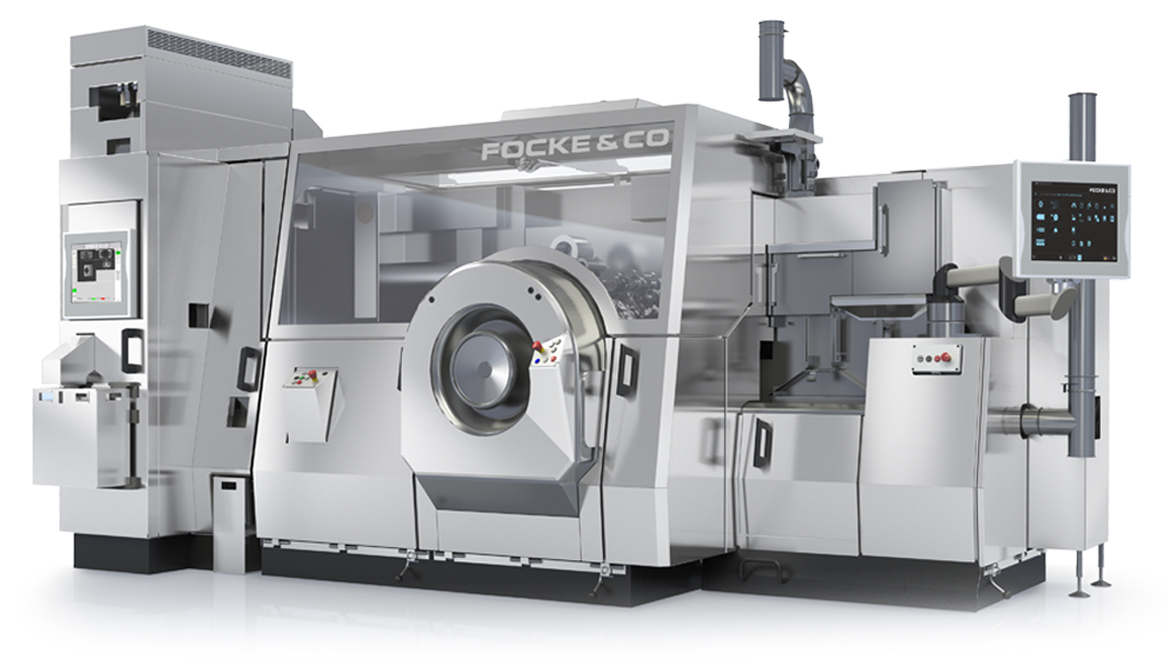
Focke Soft Cup Series — soft pack packing machine. Image © Focke & Co.
1. Focke Packing Machines: A Reliable Choice for Small-to-Mid-Size Factories
Focke & Co. (Verden, Germany) has been a significant force in tobacco packaging machinery since its founding. While competing directly with GD in the premium segment, Focke's 350 and 400 series packing machines have achieved substantial installed bases among small-to-mid-size factories worldwide — thanks to German precision engineering and modular design.
Key Model Overview
| Model | Type | Standard Output | Key Advantage |
|---|---|---|---|
| Focke 350 | Soft pack packer | 400–500 p/min | Classic reliability, maintenance-friendly |
| Focke 400/406 | Hinged-lid packer | 400–600 p/min | Multi-format flexibility, PLC control |
| Focke 408 | Upgraded hinged-lid | 500–600 p/min | High speed, precision |
| Focke 486 | Case packer / bundler | 5-15 cases/min | Downstream integration |
For small-to-mid-size factories, the Focke 350 and 400 series are the most common choices — purchase costs are far below latest-generation machines, maintenance requirements are relatively manageable, and the second-hand equipment market is active globally.
2. The Real OPEX Impact of Spare Parts Costs
The cost of packaging line downtime is severely underestimated. Using the Focke 400 hinged-lid packer as an example:
Cost of Unplanned Downtime (1 Hour)
- Output loss: ~30,000 packs/hour
- Idle labor costs
- Downstream process backlog
- Estimated total: $2,000-5,000/hour
vs. Preventive Replacement Cost
- Cutter set: $200-500
- Embossing roller assembly: $400-800
- Inner frame cutter: $100-300
- Nozzle assembly: $50-150
Key insight: Focke packing machine spare parts management is not about "saving money" — it's about OPEX predictability. Proper inventory planning combined with high-quality replacement parts can reduce annual spare parts TCO by 20-35%.
3. Focke Critical Spare Parts Classification & Selection Guide
3.1 Wear Parts (High Replacement Frequency)
| Spare Part | Applicable Models | Average Life | Alloy Recommendation |
|---|---|---|---|
| Inner frame cutter | 350/400/406 | 2-4 weeks | HSS or TCT carbide |
| Aluminum foil cutter | 400/406/408 | 3-5 weeks | TCT carbide (3-5x life extension) |
| Embossing roller assembly | 350/400 | 6-8 months | Special alloy steel, precision embossing |
| Packaging die | 400/406 | 12-18 months | Tool steel + surface treatment |
| TCT blade | 406/408 | 4-6 weeks | Carbide tip insert |
3.2 Fatigue Parts (Medium Frequency)
| Spare Part | Applicable Models | Notes |
|---|---|---|
| Conveyor / suction tapes | All series | Rubber material, OEM spec recommended |
| Pneumatic tension system | 350/400 | Cylinder + seal kit |
| Nozzle sets | 400/406 | Glue nozzles, prone to clogging |
| Wheel assemblies #1-#8 | 350/400 | Precision gear sets |
| ES modules (07/29/33) | All series | Electrical control modules |
3.3 Selection Paths
- OEM original — Highest cost, baseline life. Best for: warranty period / critical components.
- High-quality replacement — ZTLibre's focus. Moderate cost, 80-120% of OEM life. Best for: routine wear/fatigue parts.
- Carbide upgrade — 200-300% of OEM life. Best for: high-frequency cutting parts.
4. ZTLibre's Alloy Expertise: Not All "Replacement Parts" Are Equal
Focke equipment demands exceptional spare parts precision — German-designed tolerances typically fall within IT6-IT7 (micron level). A seemingly simple cutter with incorrect material can lead to triple the downstream downtime.
ZTLibre's Core Capabilities
Alloy matching — For Focke high-frequency wear parts, we recommend optimal alloy formulations based on actual machine operating parameters (speed, pressure, material):
- High-cobalt cemented carbide → high-frequency cutting on hinged-lid lines
- Micro-grain tungsten carbide → fine cutting on soft pack lines
- Reverse engineering precision — Starting from OEM sample parts, ensuring tolerances match OEM levels
- Batch consistency — Every batch undergoes hardness testing + dimensional inspection; no batch-to-batch variation
- Lifecycle data accumulation — Tracking actual service life for every part type to guide precise replacement intervals
5. Delivery Speed: How to Minimize Downtime Windows
| Part Type | Standard Delivery | 48h Emergency | Recommendation |
|---|---|---|---|
| Cutter type (TCT/HSS) | 5-10 working days | ✅ | Stock 2 sets |
| Embossing roller assembly | 10-15 working days | ❌ Custom | Order 3 months ahead |
| Packaging dies | 15-20 working days | ❌ Custom | Plan quarterly |
| Standard electrical modules | 3-5 working days | ✅ | Stock 1-2 pieces |
| Conveyor / suction tapes | 7-10 working days | ✅ | Stock 1 set |
Key principle: Establish a Red/Yellow/Green inventory system — Red (critical + long lead time) → always in stock, Yellow (critical + short lead time) → fast replenishment, Green (non-critical) → on-demand sourcing.
6. Maintenance-as-a-Service: From Part Supplier to Maintenance Partner
Many small-to-mid-size factories have limited maintenance teams. ZTLibre's approach goes beyond "selling you a part" — we provide:
- Spare parts life prediction — Early warning of replacement windows based on your machine operating data
- Installation guidance documentation — Step-by-step installation/calibration guides for critical parts
- Inventory optimization advice — Calculate optimal stock levels and mix ratios
- Emergency technical support — Remote guidance or on-site assistance
Goal: Shift from reactive maintenance (fixing after failure) to proactive maintenance (planned replacement), increasing Focke packing line OEE (Overall Equipment Effectiveness) by 5-10%.
7. Quick Action Checklist
If you have a Focke 350 or 400 series packer in production, check these 5 items today:
- Has the blade wear indicator been triggered? (Replacement window ≈ 1-2 weeks)
- How many months has the embossing roller been in service? (Consider replacement at 8 months)
- Is the pneumatic tension system making any unusual noises?
- Does your parts inventory include at least 1 set of critical cutters?
- Was the last unplanned downtime caused by parts shortage?
